
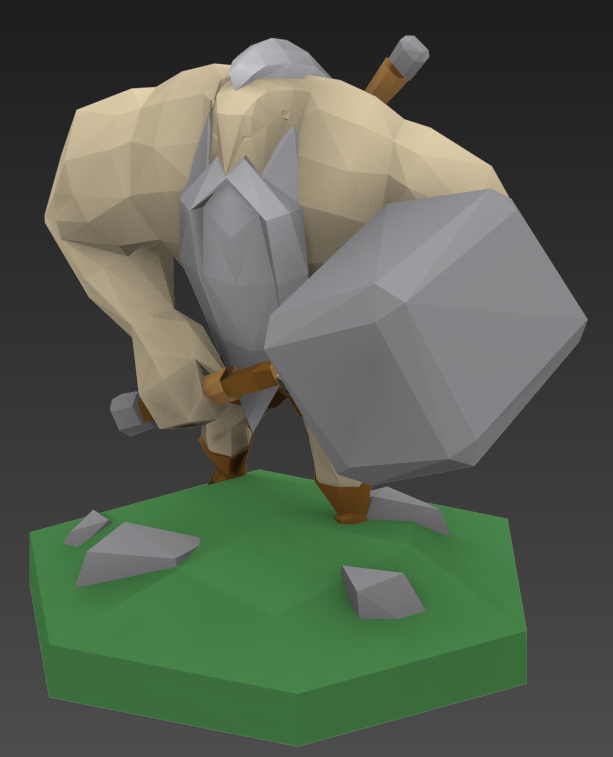
During our few weeks of development, me and Lui have been talking about the core mechanics of the game, its general rules, what our future plan should be and much more. One of the most important things we’ve decided is our art style. As we only have Lui doing the art, we needed an art style that could be cost effective, works great digitally and can be printed for the table top version.
Art Style
So we looked at a few of our old alternatives, talking about the time schedule we have and how hard it is to do; and found that low poly is the best decision for us.
Not only are we able to dish out the art in a mediocre pace, we are also able to generate something that looks exactly like a board game, generating something that is familiar in a pace that allows us not to strain ourselves.
This is, of course, a first draft, with very little details
The Berserks from Arbor
Virian
Olof (right up there) hails from the Virian steppes in Arbor. With no tame animals and no metallurgy, the tribes that occupied these lands resorted into raids of neighboring kingdoms, marking themselves as savages and looters in the common folk. It is said that kingdoms that were connected to Virian sent their outcasts there, One particular batch of people were the mountain people from the south. After bargaining a truce with the Hildegarn tribe, the mountain people taught them their metallurgical secrets and metallic locations in exchange of suffrage. Hildegarns, after an age of raiding, were broad shouldered, short in stature and possessed massive upper body strength. With their allies, they took over the metal mines and forged massive weapons.
The only city in Virian
After getting rid of their predatory threats in their lands, they united their steppe brothers and built the only city ever to stand in the Virian steppes and named it Mamrí, the metal city. As trees were scarce, metallic structures paints the view of the city with stone foundations.
Economy
Mamrí had a small trade economy with food and wood traded with metal from their mines. During the years, deals were struck with kingdoms to provide enough wares for necessities and during sieges, they would use their massive food storage of local food. By doing this, they made sure the neighboring kingdoms were weak enough never to think about conquering the boulder of the steppes.
Army
Their army consisted of six types of fronts, the scouts, raiders, long runners, berserks, city guard and finally the city folk.
The scouts would mark the environments around Mamrí in order to check for activity, becoming the all seeing eyes of the steppes.
The raiders kept the inflation of Mamrí down by targeting trade routes that were providing materials and wares that were already sufficient in, accumulating a sufficient storage of wares and materials to control the market.
The Virian steppes is a harsh environment to traverse through, in order to get a message through, long runners were employed to run through, often dangerous and occupied plots of land to deliver a message.
The berserks made up the bulk of the army, these soldiers were equipped with the strongest metal found in the mines and also the biggest (Hint: Olof). Their army consisted in groups of ten with ten making up a group, 100 an assault group and 1000 the whole army, never less, never more. Though many would train to become one (almost half of Mamrí), the army never needed to become stronger than a thousand as any threats have been able to be dealt without expanding the berserker front.
With the city only becoming besieged once, the city guard and troops consisted mostly of berserker trained women and men, the city have been able to fend off any attackers since Mamrí’s conception.
Modern History
The Hildegarns never really had a imperialistic mind, during the ages, they would fortify their city, trade with Virian villages and only engage in war when threaten, generating a long lasting kingdom. As the city Tivla would expand their borders and begin conquering all of Arbor, the berserks of Hildegarn were the last to submit after 199 years of unsuccessful besiegement.
Because of their endemic culture, myths mentioned that the berserks would rarely eat meat but ate their weak and young, engaged in polygamy and their women were all slaves gathered from trades. When the king of Tivla finalized his conquest, Mamrí opened its doors after nearly 200 years of isolation. Apparently, these massive berserks were well mannered, had beautiful local women and their trade were exclusively jewelry.
With Arbor finally united, Hildegarns never converted their religion and still practice a matriarchal pantheon of warring goddesses; nor did they allow any tribute to be demanded, becoming the only free city on the planet. It would however allow its weapons to be infused with Omni and if a citizen would volunteer, be a specialized soldier in the colonial army against the Vi.
Aesthetic goals
Aesthetic goals in game development are the feelings you want to convey when gamers are playing your game. These are the goals all aspects of the game point to.
So what are we striving for this game ? competition ? co-operation ? Strategy ?
Well, all of them actually. For us, we are looking to make a game that’s has human obstacles, is a social framework and works as a past-time game.
A promise
We did mention this before but to put it into a constitution, we offer no random elements in our game from start to finish. It is not because we despise those games but we look at Worlds at War as a fully skill-based game and skill-based games do not have random elements. People that have a more tactical mind and can co-operate better than the opposing team will win, every time.
End Note
So there you have it, Olof the berserker from Mamrí is the berserker class, low poly will be our art style, our aesthetic goals are competition, co-operation and strategy, and we will never have any random elements in the game.
 Game Blog